
Introduction
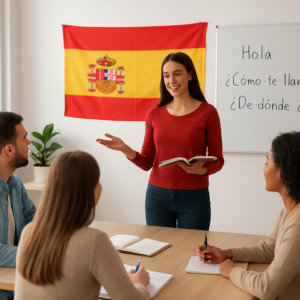
Choosing one of the best Spanish schools in Valencia has to offer is only step one. This practical field guide shows how to pick the right course, build a weekly routine that forces speaking practice, and turn Valencia streets, markets, and cafés into low-cost immersion labs. You will get specific daily plans, classroom tactics for small hands-on classes, and Valencia-specific activities and tools to use right away to speak faster.
At Survival Spanish, we’ve spent years helping learners move from hesitant beginners to confident speakers — not through grammar drills alone, but through the kind of real, pressure-tested conversation practice that actually sticks. As a conversation-first school right in the heart of Valencia, everything we teach is built around one question: will this help you speak today, in a real Valencia situation, with a real person? That philosophy shapes every section of this guide.
Whether you are already enrolled with us or still comparing options among the best spanish schools valencia has to offer, the strategies here will sharpen your approach, close the gap between classroom learning and street-level fluency, and make your time in Valencia count for twice as much.
Choose the right Valencia school and course type
Reality check: when people search for the best spanish schools valencia, flashy websites and five star reviews become a distraction. The difference that matters is what actually happens in class: how much speaking you will do, who corrects you, and whether the syllabus ties lessons to real Valencia situations.
What to measure – hard criteria, not marketing
- Class size: smaller than 8 students for guaranteed speaking turns
- Student output per lesson: ask for expected minutes of student speaking versus teacher talk
- Teacher credentials and experience: CELTA/DELE exam trainers are useful but prioritize classroom coaching skill
- Syllabus focus: task-based or conversation heavy rather than grammar-only
- Schedule flexibility: can you swap or add classes when work or travel interferes
- Location and context: proximity to Mercado Central, Ruzafa, or your neighbourhood matters for outside practice
- Price transparency and extras: clear daily/hourly rates and what practice activities are included
Tradeoffs to accept: intensive morning courses accelerate progress fastest, but they require daily recovery time and may not fit a job schedule. Evening group classes are cheaper but often have less speaking time and more textbook work. Private lessons speed correction but reduce peer practice; combine both if you can.
Concrete example: Survival Spanish offers small hands on morning classes designed to force speaking and immediate feedback; compare that with International House Valencia, which runs structured general courses and DELE prep, and Taronja School of Languages, which has adult evening options for working learners. If your goal is everyday fluency, pick the small, conversation-first option and use exam courses later only if you need certification.
- Checklist to ask on a trial lesson: How many students per class and average speaking minutes per student? Do teachers provide targeted corrective feedback or only post-class notes? Can I sit a trial class or get a short recorded clip of a real lesson? What homework system do you use and is it tied to class vocabulary? Do you run local immersion activities or conversation tandems?
Practical next step: book trial lessons at two different models – one small conversation school and one larger structured school – and compare the actual speaking time you get during those trials. Use that observation to pick course type, then plan the weekly routine around that choice.
If real speaking is the goal, choose output over reputation. Then use classes as the backbone for daily micro-practice around Valencia.
Design a weekly routine that produces rapid gains
Start with output as the anchor. If your week does not force you to speak for at least three focused sessions, you will stall. Build the schedule around class time that maximizes student talking time, then wrap short, high-quality practice on the other days.
Weekly schedule template – target 10 to 15 hours
| Day | Core activity | Duration and focus |
|---|---|---|
| Monday | Morning intensive class + 10 minute Anki review | 90 min class (speaking heavy). 10 min SRS: new 8 cards from class. |
| Tuesday | Shadowing + short conversation exchange | 20 min shadowing teacher audio. 45 min tandem – task: order at a cafe. |
| Wednesday | Morning intensive class + micro-speaking drill | 90 min class. 10 min timed 1 minute monologue recording. |
| Thursday | Anki + targeted grammar fix | 30 min SRS and 30 min focused drills on two recurring mistakes from recordings. |
| Friday | Language exchange or private lesson | 60 min 1:1 for error correction or 60 min group chat led by you – focus: practical phrases. |
| Saturday | Cultural outing practice | 60 to 90 min at Mercado Central or Ruzafa cafe – use 10 prepared phrases and 5 new words. |
| Sunday | Passive listening + weekly review | 30 to 60 min Coffee Break Spanish and 5 minute review of week recording; plan next week. |
Practical insight: short daily SRS beats long weekend cramming. Spend 10 minutes after class creating the Anki cards you will actually use in Valencia – cafe phrases, transport questions, and the verbs your teacher corrected. Use Anki and tag cards by lesson so drills are automatic.
Tradeoff to accept: heavy morning intensives accelerate gains but require recovery and deliberate reuse of vocabulary the same day. If you work afternoons, swap one class for a private 30 minute correction session in the evening to keep momentum without burnout.
Concrete example: Maria, a digital nomad, took two 90 minute conversation classes at Survival Spanish and followed the table above. She recorded a 1 minute weekly monologue, used Anki for 10 minutes daily, and spent Saturdays buying food at Mercado Central using prepared phrases. After eight weeks she moved from halting replies to asking follow up questions in market conversations.
Micro-exercise 1: 2 minute market script – write and memorize five lines you will say at a stall. Use them until fluent, then swap one phrase each week. Micro-exercise 2: Weekly 60 second challenge – record a spontaneous 60 second answer to a prompt from class, note three recurring errors, and practice only those errors in the next three days.
Focus time plus deliberate reuse equals fast progress – passive exposure alone will not convert classroom learning into conversational habit.
Next consideration: track one measurable speaking target each week – minutes spoken in tandems or number of successful real-world transactions – and adjust the schedule based on that single metric.
Get speaking from day one with targeted classroom strategies
Hard fact: you will not get comfortable speaking unless you design the first lessons to force output. Teachers and classmates can help, but you must own the structure that guarantees uninterrupted turns and real tasks from lesson one.
How to convert a passive lesson into a speaking workshop
Quick action to take on day one: tell the teacher you want two uninterrupted speaking slots each lesson and ask for feedback right after those slots. Framing this as an experiment — I want to test my spoken fluency — gets cooperation without sounding demanding. Use a trial class to confirm they will honour those slots.
Classroom tactics that actually work: run short, real-world tasks that require negotiation and follow-up questions rather than scripted lines. After the task, get focused correction on patterns, not every mistake. This preserves fluency during the activity and gives actionable targets afterward.
- Micro-task idea: 3-turn negotiation – student A requests something, B refuses, A proposes a compromise. Repeat swapping roles.
- Community task: plan a two-stop itinerary (market + cafe) with budget and ask classmates to challenge it.
- Functional drill: make or refuse an appointment over the phone, then role-reverse with feedback on key phrases.
Practical insight and tradeoff: immediate correction during a performance kills risk-taking; delayed corrective feedback focused on 2–3 recurring errors produces faster long-term gains. Expect an initial awkwardness when teachers switch from sentence-correcting to pattern-correcting — it feels softer but works better.
Concrete example: in a Survival Spanish morning class a teacher turned a grammar warm-up into a 10 minute town-service simulation: students called a mock utility company, reported a problem, and negotiated a visit. Each student then received two focused corrections: useful phrasing and one repeated pronunciation target. After three sessions the group stopped avoiding phone interactions and volunteered for real calls outside class.
How to shape class without sounding pushy: offer to lead a five minute conversation starter or bring a short, real task from Valencia (an actual Mercado Central purchase or a catalogued TV listing). Teachers appreciate concrete proposals and you control the speaking stakes.
Next consideration: if a school cannot or will not rearrange lessons to guarantee short, repeated speaking pushes, it is not one of the best spanish schools valencia for fast conversational progress. Try a different course or request a short private follow-up session focused only on error patterns.
Exploit small class advantages to accelerate fluency
Small classes give you a speed advantage — if you use them as a lab, not a lecture theatre. With six or fewer students the group becomes a testing ground: you can run short experiments, get rapid correction, and fold classroom failures into the next activity the same day. Most learners treat small groups like gentler versions of big classes; that wastes the leverage you paid for.
The real problem to solve is friction: without a clear structure those extra minutes of teacher attention dissipate into polite conversation or grammar explanations. The solution is a set of low-cost routines that convert teacher time into repeated, targeted speaking practice and fast error elimination.
Practical routines to implement this week
- Error bank sprint: one student records a 60–90 second speaking sample. Teacher adds recurring errors to a shared document. Next activity is a three-minute sprint where everyone must produce corrected versions of those sentences.
- Peer-teach five: rotate one student per class to prepare a five-minute mini-lesson on a real Valencia task (buying tickets, asking about siesta hours). Teaching forces accuracy and vocabulary retrieval.
- Live feedback signals: agree on nonverbal signals for immediate micro-corrections (tap table = pronunciation, hold up 1 finger = single-phrase recast). Keeps flow while still giving on-the-spot guidance.
- Recorded mini-sprints: capture one roleplay each session and replay a 30 second extract for focused drilling — teachers can timestamp exact targets, students repeat until natural.
- Accountability tandems: pair learners for outside 20 minute tasks; pairs swap a short checklist from class to force specific phrase use and report back next lesson.
Tradeoff to accept: small groups magnify teacher skill and limit accent variety. You get intense correction but fewer distinct voices. Counter this by inviting guest speakers (a local shopkeeper for 20 minutes) or swapping partners between nearby schools. If your teacher cannot run rapid cycles, push for recorded sprints so the feedback still happens.
Concrete example: at Survival Spanish a three-student morning cohort uses an error bank plus a weekly student-teach slot. Students record a two-minute checkout simulation, the teacher pulls three recurring problems, and the next class begins with a targeted three-minute repetition drill. The result: predictable, repeated practice on the same items until they stop failing in real transactions.
A common mistake is polishing sentences instead of rehearsing messy real interactions. In practice, fluency is built by recycling the same imperfect structures under pressure until correction changes the default. Reserve polished accuracy work for later — early progress needs messy repetition.
Next consideration: propose two student-run activities to your teacher this week — the class either becomes an accelerated fluency lab or it remains an ordinary lesson. Choose which you want.
Use Valencia specific immersion opportunities
Practical reality: Valencia is full of low-friction places where you can convert classroom phrases into real transactions — but most learners treat these as sightseeing, not practice labs. That wastes time and stalls spoken progress.
Problem: cold immersion rarely works. Walk into Mercado Central or a Ruzafa cafe without a short script or objective and you get polite Spanish, code-switching to English, or a quick transaction that doesn’t challenge you. Solution: go with a micro-contract: a short, repeatable task and a 3-line script you will use until it feels natural.
How to turn local spots into repeatable practice drills
Do this before you go: prepare 5 phrases tied to the expected exchange, write them on an index card, and tag corresponding Anki cards. Do this during the interaction: use the full script, ask one spontaneous follow-up question, and record the exact phrasing you needed afterward. Do this after: add the real variant to your SRS deck and practise the error you made that same evening.
| Valencia spot | Target practice | Follow-up drill |
|---|---|---|
| Mercado Central | Buying produce – quantity, price negotiation, asking for recommendations | Record vendor reply, add 2 vendor phrases to Anki, repeat next market visit |
| Ruzafa cafes | Ordering, small talk about local events, asking for bill split | Replay recording, shadow vendor intonation, rehearse alternative responses |
| Neighborhood associations or volunteer shifts | Explaining availability, confirming instructions, giving/asking for help | Write a short 30 second summary of your shift in Spanish and present it in class |
| Small businesses (shoe repair, tobacconist) | Problem description and negotiating pick-up times | Practice phone-call version with a classmate; keep a script for real calls |
Tradeoff to accept: these immersion tactics push you into awkward, imperfect interactions. Locals may switch to Valencian or English, and some business owners are too busy for long chats. That is normal. The objective is targeted pressure, not a friendly long conversation every time.
Concrete example: Marta committed to a weekly 45 minute practice at Mercado Central. She chose three vendor stalls, used the same five-line script at each, and after every stall added vendor phrases to her Anki deck. Within four weeks she stopped hesitating, started asking follow-up questions, and her teacher used one market roleplay to mimic real vendor responses in class.
Practical judgment: immersion without scaffolding is busywork. The most effective use of Valencia is structured repetition in real contexts – short scripts, immediate review, and SRS integration. If you need a place to start, arrange a supervised outing through your school or use a local mini-task from Survival Spanish so class practice and street practice align.
Next consideration: schedule one scaffolded immersion each week that your teacher knows about so class drills and street practice reinforce each other.
Use technology and media strategically to complement classroom learning
Start with alignment, not novelty. Technology only helps when it is tightly linked to what happens in class. Pick tools that let you capture teacher corrections, recycle classroom vocabulary, and force speaking under real constraints. Avoid the temptation to collect apps; choose a small stack and use it deliberately.
The three-tool stack that actually moves the needle
- SRS for retention: use
Ankito turn teacher-corrected sentences, real vendor replies, and pronunciation clips into 8 to 12 targeted cards per lesson. How to use: create cards after class, tag by lesson, and include audio from your teacher or your own recording. Anki syncs across devices so you can review on short breaks. - Guided conversation channel: pick one live-speaking outlet for structured practice – either Tandem/HelloTalk for low-cost tandems or a weekly targeted
italkilesson for correction. Tradeoff: tandems give variety but inconsistent feedback; pay-for sessions give focused correction but cost more. - Graded listening + active transforms: start with a short episode from Coffee Break Spanish or a local clip, then convert it into active work by transcribing 90 seconds and producing a 1 minute oral summary. Passive radio or TV without active follow-up is a waste of time.
Practical limitation: native-speaker partners often default to translation or conversation topics that do not match your classroom targets. Protect your speaking time by bringing a 10 minute task to every exchange – a market script, a complaint call, or a roleplay – and ask your partner to stick to that task for the first half of the session.
Concrete example: Lucia uses a Survival Spanish class correction as the source for three Anki cards every day. Twice a week she books a 30 minute Tandem session to practice a supermarket script and once every ten days she takes a 45 minute italki lesson for focused error correction. She pairs each listening episode from Coffee Break Spanish with a 10 minute transcription sprint. After six weeks she stopped hesitating when vendors asked follow-up questions.
- How to turn passive media into practice: pick a 90 second extract, transcribe it, note two useful phrases, shadow the audio for pronunciation, then add those phrases to your SRS.
- Avoid fragmentation: limit yourself to two actively used apps and one correction channel. Switching tools every week fragments input and wastes the time you should be spending speaking.
- Data hygiene: tag every card with the lesson number and context – market, cafe, phone call – so you can pull focused drills before real outings in Valencia.
Daily micro-workflow you can start tonight: after class spend 10 minutes creating Anki cards from teacher corrections; during your commute listen to a 15 minute Coffee Break Spanish episode and shadow one phrase; schedule one short Tandem or italki task-based session for the week and come with a 3-line script. Small, repeated cycles beat sporadic marathon study.
Use tech to extend the classroom loop – capture, practice, test in real Valencia situations – not to escape the hard work of speaking.
Measure progress, adjust the plan, and prepare for certification if needed
Measure something real every week. Pick one observable metric you can reproduce: a 2 minute recorded roleplay, the number of vendor interactions you completed without switching to English, or an error-class count (pronunciation, verb tense, lexical gaps). Consistent, comparable samples reveal whether your practice is changing automatic responses or just polishing isolated phrases.
A simple diagnostic you can run in 10 minutes
Run the same three-part check every seven days and keep the files. 1) Task performance: perform a 2 minute roleplay that imitates a Valencia transaction (market, cafe, or phone call). 2) Comprehension test: listen to a 90 second local clip and write a 50 word summary. 3) Error inventory: note 3 recurring mistakes and whether you corrected them in the recording. These components show fluency, listening, and remediation — the three things that actually matter for day-to-day Spanish in Valencia.
- How to score it: give yourself a quick pass/fail on the task, count interruptions or code-switches, and mark whether each of the 3 recurring errors appears. Failing a task once is fine; failing it three weeks in a row triggers an adjustment.
- When to adjust intensity: if two diagnostics in a row show no reduction in recurring errors, increase targeted correction time (private lesson or focused drills) rather than piling on more passive hours.
- When to add exam prep: only start structured DELE or SIELE preparation once your weekly diagnostics show stable, spontaneous speech across tasks; exams reward accuracy under pressure, so premature exam study often hardens testy phrasing instead of improving flow.
Tradeoff to accept: shifting hours toward certification practice sacrifices exploratory speaking time. In my experience, students who begin intensive DELE drills too early become more accurate but less willing to risk conversational turns in markets and cafes. If your priority is everyday fluency, keep at least 70% of your active weekly hours on unscripted, high-pressure speaking and 30% on exam techniques until two months before a scheduled test.
Concrete example: Javier needed DELE B2 for a job but arrived in Valencia with shaky spoken fluency. He kept his morning conversation classes at Survival Spanish, added a single 45 minute private session weekly for targeted error correction, and began recording the same 2 minute cafe roleplay every Sunday. After six weeks the recordings showed fewer hesitations and Javier switched to two exam-style mock oral sessions per week while maintaining conversation classes — he passed B2 without losing the ability to handle unscripted market conversations.
Practical adjustment checklist: if diagnostics stall, choose one of three targeted fixes: increase tandem frequency for raw output, add a single weekly 1:1 for pattern correction, or schedule a teacher-led simulation that mirrors the DELE speaking rubric. Each fix buys a different result — more variety, faster error elimination, or familiarity with exam pacing — so pick according to your immediate goal, not what sounds efficient.
Judgment you need: most learners overvalue early certificates. Certification matters for jobs and residency, but it is not a shortcut to being understood on the street. Treat exams as a targeted project with its own timeline — integrate exam practice only when your diagnostics show conversational stability, and use school courses that can pivot between fluency work and exam drills (see Survival Spanisho overview if you need flexible options).
Takeaway: measure with repeatable tasks, change only one variable at a time, and postpone heavy exam drills until your spontaneous speaking is reliable.
Frequently asked questions about the best Spanish schools in Valencia
What makes the best Spanish schools in Valencia different from other language schools?
The best Spanish schools valencia offers prioritize real speaking output over passive grammar instruction. They maintain small class sizes (typically fewer than 8 students), use task-based syllabi tied to everyday Valencia situations, and provide targeted corrective feedback rather than general post-class notes. When comparing options, ask how many minutes of student speaking a typical 90-minute class contains — the answer reveals more than any review or ranking.
Is Survival Spanish one of the best Spanish schools in Valencia for conversation practice?
Survival Spanish (www.survivalspanish.es) is specifically built around conversation-first methodology, making it a strong fit for learners whose primary goal is everyday spoken fluency in Valencia. Small morning groups, immediate corrective feedback, and lesson content tied to real Valencia contexts — markets, cafés, local services — distinguish it from larger, more exam-oriented schools. It is not the only strong option, but it is one of the most targeted if spoken fluency is the priority.
How long does it take to reach conversational fluency at the best Spanish schools in Valencia?
With consistent intensive study — 90-minute classes three to four times per week plus daily SRS review and at least one structured immersion outing per week — most learners move from near-zero to basic conversational competence in 8 to 12 weeks. Reaching comfortable B1-level fluency typically takes four to six months of the same routine. The variable that matters most is not the school but the ratio of active speaking practice to passive study time.
What should I look for when comparing the best Spanish schools Valencia has available?
Focus on four practical criteria: class size (under 8 students), student speaking time per lesson (aim for 40+ minutes out of 90), teacher correction style (targeted pattern feedback beats sentence-by-sentence correction), and whether the school offers a trial class. Marketing language, star ratings, and social media presence are poor proxies for the quality of speaking practice you will actually get.
Are the best Spanish schools in Valencia suitable for complete beginners?
Yes — most reputable schools, including Survival Spanish, run structured beginner tracks designed to get students speaking usable phrases from the first session. The key is choosing a school that applies the same output-first principles at A1 level, not one that defaults to grammar-only instruction for beginners. Ask specifically whether beginners do speaking tasks or primarily written and translation exercises in the first two weeks.
Can I combine classes at one of the best Spanish schools in Valencia with self-study?
Absolutely — in fact, combining structured classroom practice with a deliberate self-study routine (Anki for SRS, shadowing for pronunciation, tandem exchanges for variety) is the fastest path to fluency. The weekly schedule template in this guide is built exactly for this combination. Classes provide correction and accountability; self-study extends daily speaking exposure beyond what any school can offer in a few hours per week.
Do the best Spanish schools in Valencia also prepare students for DELE exams?
Several do, though there is a meaningful difference between schools that integrate exam prep into conversational courses and those that run parallel grammar-focused exam tracks. The most effective approach — followed at schools like Survival Spanish — is to build strong conversational foundations first, then layer in exam technique once spontaneous speech is stable. Students who attempt DELE preparation before reaching reliable conversational fluency often become more accurate but less willing to take conversational risks.
How does Valencia’s environment help learners at the best Spanish schools here?
Valencia offers unusually rich low-cost immersion opportunities — Mercado Central, Ruzafa cafés, neighbourhood associations, and small local businesses are all within easy reach and staffed by people who will engage in Spanish if approached with a script and genuine intent. Schools that connect classroom content to specific local tasks give students a structured reason to use those environments, making Valencia itself a practice lab rather than just a backdrop.
Final thoughts: turn Valencia into your classroom
Finding one of the best spanish schools valencia has to offer matters — but it is the beginning of the process, not the end. The schools, tools, routines, and immersion tactics covered in this guide are all designed around a single principle: speaking more, in real situations, with real feedback, repeated often enough that it becomes automatic.
Valencia is an exceptional city to learn Spanish precisely because the classroom and the street are never far apart. A morning lesson at Survival Spanish can become a Mercado Central drill by lunchtime, a Ruzafa café conversation by mid-afternoon, and a reviewed Anki deck by evening. That loop — learn, use, review, repeat — is what separates learners who progress quickly from those who plateau after a few weeks.
If you are still deciding between the best spanish schools valencia offers, the clearest test is this: sit a trial class and count how many minutes you actually spend speaking. If the answer is fewer than 30 minutes in a 90-minute session, look elsewhere. If it is closer to 40 or 50, you have found a school worth committing to.
At Survival Spanish, our morning conversation classes are built around exactly that standard. We keep groups small, tie every lesson to real Valencia situations, and measure progress in terms of what you can say and do — not just what you know. If that approach sounds right for where you are in your language journey, we’d love to have you in class.
Browse our courses at www.survivalspanish.es or drop us a message to arrange a trial session. Valencia is waiting — and so is the Spanish you’ve been meaning to learn.